


No, you didn’t read it wrong. Yes, I was as surprised as you. With my role at risk of redundancy, I’ve had a chance to do some more API-tinkering and lo and behold, esports is alive! You heard it here first.
There’s plenty of great coverage of prediction markets out there — see Scott Longley’s Earnings & More, Steve Ruddock’s Straight to the Point, and Dustin Gouker’s The Event Horizon — but no one really talks about esports.
That’s where I’ll claim my seat. Scoot on over, gentlemen, and make space for a little one in the rather large prediction market bed.
This will be a weekly feature looking at prediction markets with an esports hat on, as well as offering a cursory overview of anything going on at the intersection of esports and gambling.
$1.32 billion traded on esports in August
Note: this analysis is focused specifically on single-leg trading volume; parlay/combo markets are excluded throughout. Trading volume reflects cumulative trading activity, not capital deposited. Unless specified, this is data taken from Polymarket Global (not US).
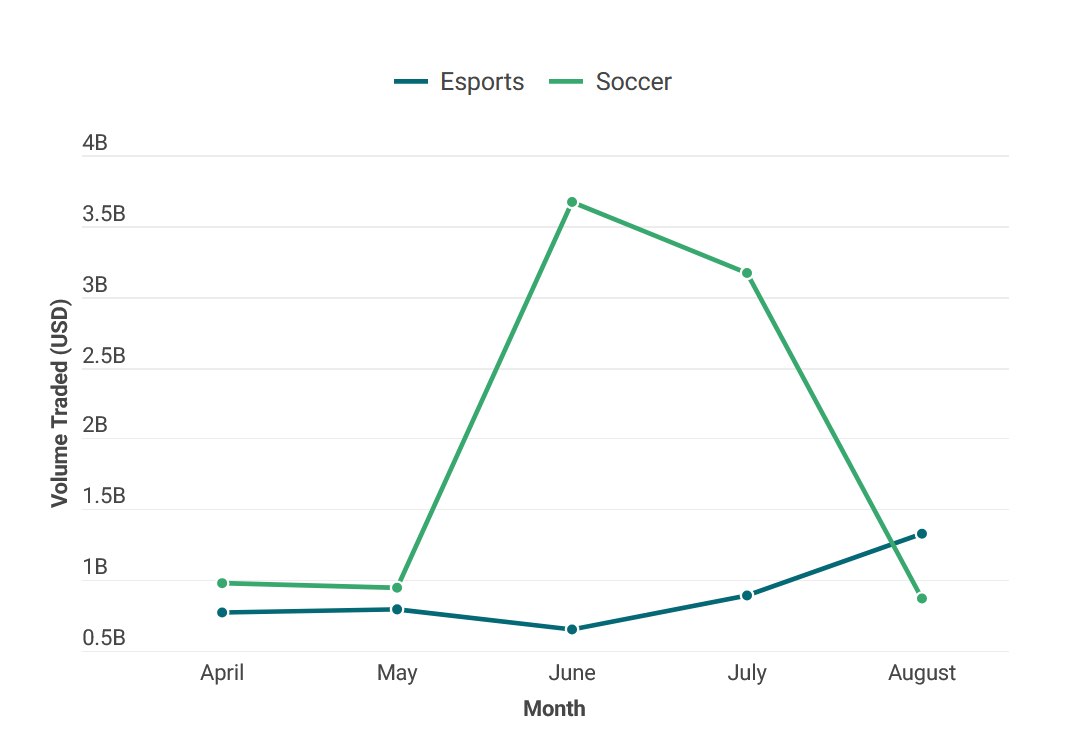
Don’t cry for me Argentina: Before the FIFA World Cup came around this summer, esports sat ~20% behind soccer in volume on Polymarket Global. The World Cup drew mammoth trading volume throughout June and July, putting soccer firmly ahead of any other category.
Premier League, Shremier League: Esports swooped in August to become the largest category traded on Polymarket, a whopping 53% ahead of soccer. That’s despite the return of domestic competition globally, with the largest esports match traded in August attracting 2x the volume of the defending champion Arsenal’s opening-weekend clash with Villa.
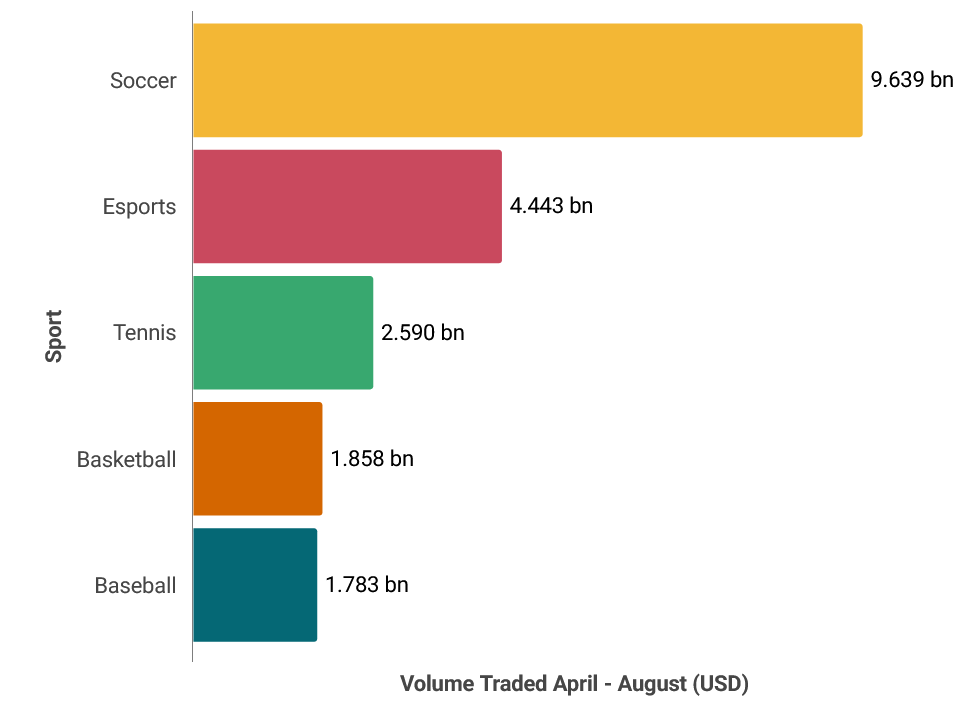
Sitting pretty: In the five months of data analysed, esports sits comfortably ahead of other sports that are typically in the conversation on US-based prediction market exchanges. It attracted more than double the trading volume of basketball and baseball and saw nearly $2 billion more than tennis, too.
The FIFA World Cup takes place every four years, and with regular league football seemingly attracting far less trading than a global knockout competition, it’ll be interesting to see if esports makes gains over football.
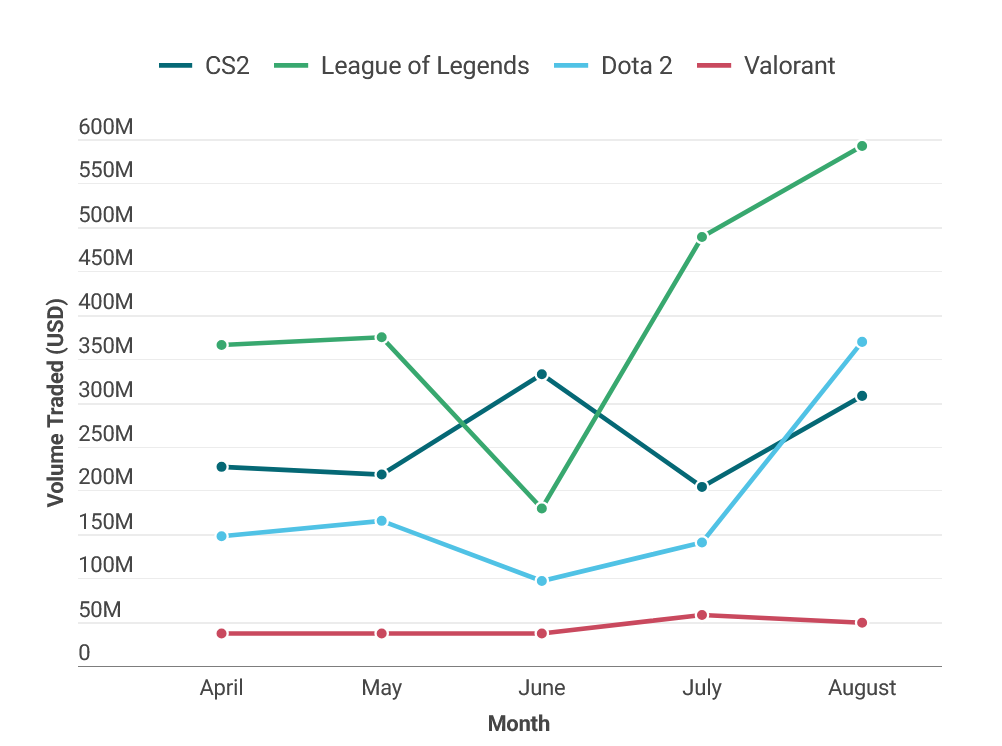
League of its own: Counter-Strike is always touted as the esports that attracts the most betting activity. Activity on Polymarket shows that League of Legends is consistently the most traded, with nearly $600 million in trading volume in August.
MSI finished in July, with August seeing the return of the regional splits and no major international competition, suggesting the volume is less sensitive to big tournament moments.
Major CS up-tick in June: The IEM Cologne Major concluded in June, and Valve’s FPS title usurped League of Legends, driven by significant interest in one of the game’s premier competitions.
Dead game?: Eight of the top ten traded esports markets in August were on matches at Dota’s flagship event, The International. Team Vision versus Team Spirit, in the best-of-five finals, attracted $26.9 million in trading on one series alone.
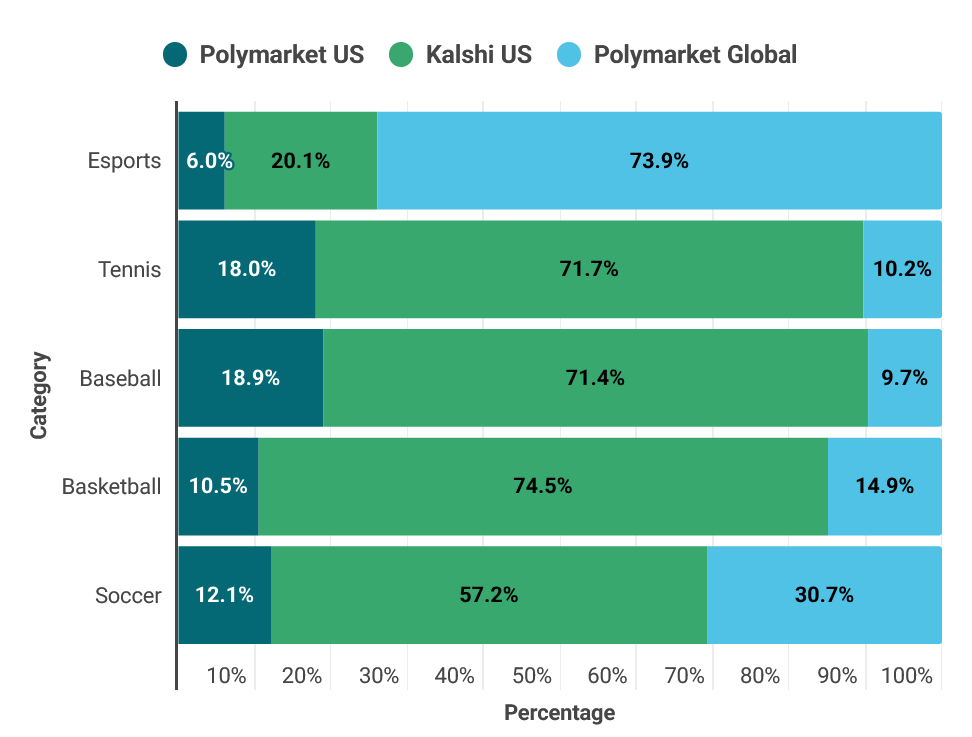
Noisy neighbour: Taking a look at Kalshi, Polymarket US, and Polymarket Global, it’s clear that esports trading has far greater interest from a global audience. I think it’s safe to say prediction markets in the States are, erm, noisy.
There’s a tangled web of lawsuits and arguments between federal agencies, state gambling bodies, and Kalshi & the gang. The aforementioned newsletters will keep you abreast of the regulatory shenanigans that seem to develop daily.
God Bless America: The data shows that US retail traders are most interested in trading sports that take place on their doorstep, and tennis, too.
~85-90% of all tennis, basketball, and baseball trading takes place on Kalshi & Polymarket US.
Given that the NFL has been in the off-season, expect it to appear in a big way in the coming months — especially on Kalshi and Polymarket US.
74% of total esports volume happens on Polymarket Global.
Leftovers: Riot considers prediction markets, GRID odds, and ESIC issues bans
Watching the people get lairy: A Bloomberg report last week revealed that League of Legends and VALORANT publisher Riot Games is weighing up prediction-markets sponsorship.
Joe Hixson, Communications Lead at Riot Games, said the company are, “evaluating with a focus on safeguarding competitive integrity, potential value for teams, impact on the fan experience, and alignment with broader ecosystem goals.”
I’ve seen numerous reactions lambasting Riot for even considering the option. But given the change in rules regarding betting sponsorship and continued interaction with the crypto exchange Coinbase, I wouldn’t trade against it…
On the GRID: Esports data-giant GRID has taken the plunge into providing an odds product. The product will offer Counter-Strike, Dota 2, VALORANT, and League of Legends and will combine its official server data with proprietary modelling and a newly built trading operation.
Features include:
Pre-match and live match/map markets.
Player props including kills, headshots, assists and deaths.
In-round markets such as first blood, bomb plant and round winner.
Direct server telemetry on GRID’s core feeds at sub-200ms latency.
Vintage ESIC behaviour: Following an investigation into a match at the Esports World Cup 2026, the Esports Integrity Commission (ESIC) has imposed a lifetime ban on Juan “Vintage” Angulo, and a five-year ban to Oswaldo “DarkMago” Herrera.
The match in question was the PlayTime versus Team Liquid match at EWC.
ESIC found that Vintage had agreed to accept a financial reward should PlayTime lose the series 2-0, and solicited DarkMago’s involvement.
Although the result was not achieved and ESIC found no proof that payment changed hands, Vintage was still found guilty on seven counts and banned for life.
DarkMago has been banned for five years for failing to meet mandated reporting and integrity obligations.
Want to work together? I’m available. Check out my website or email ollie@olliering.com.